
› Members Forum › Track › Scratch building track › Track from the Past – from Romford parts
- This topic has 6 replies, 2 voices, and was last updated 2 years, 5 months ago by
Richard Stevenson.
-
AuthorPosts
-
-
February 1, 2023 at 7:27 pm #243960
Richard Stevenson
ParticipantA visitor to our stand at the Southampton show advised that he had some old EM gauge track for disposal and wondered if anyone would be interested in it. He has sent me a sample for examination.
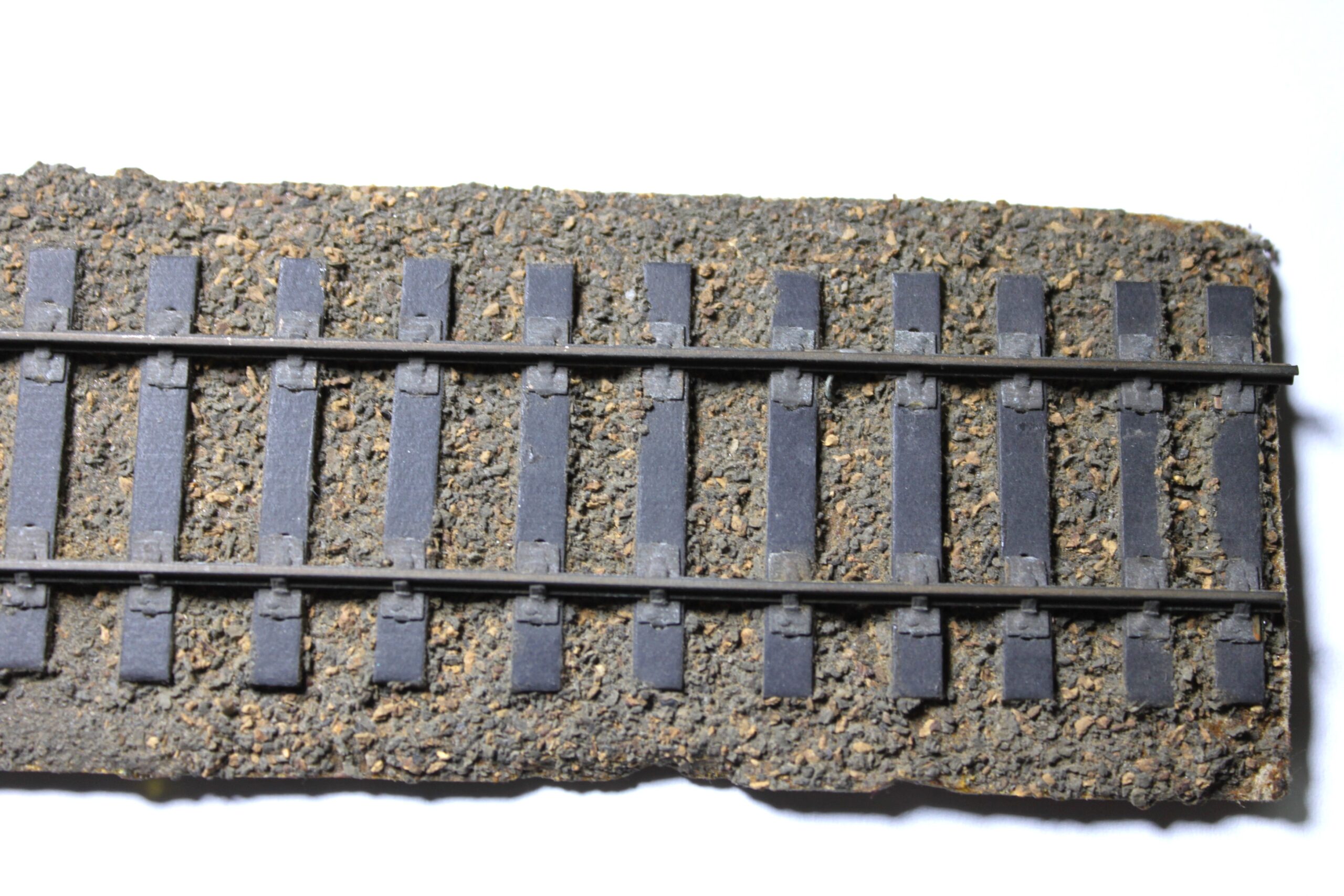
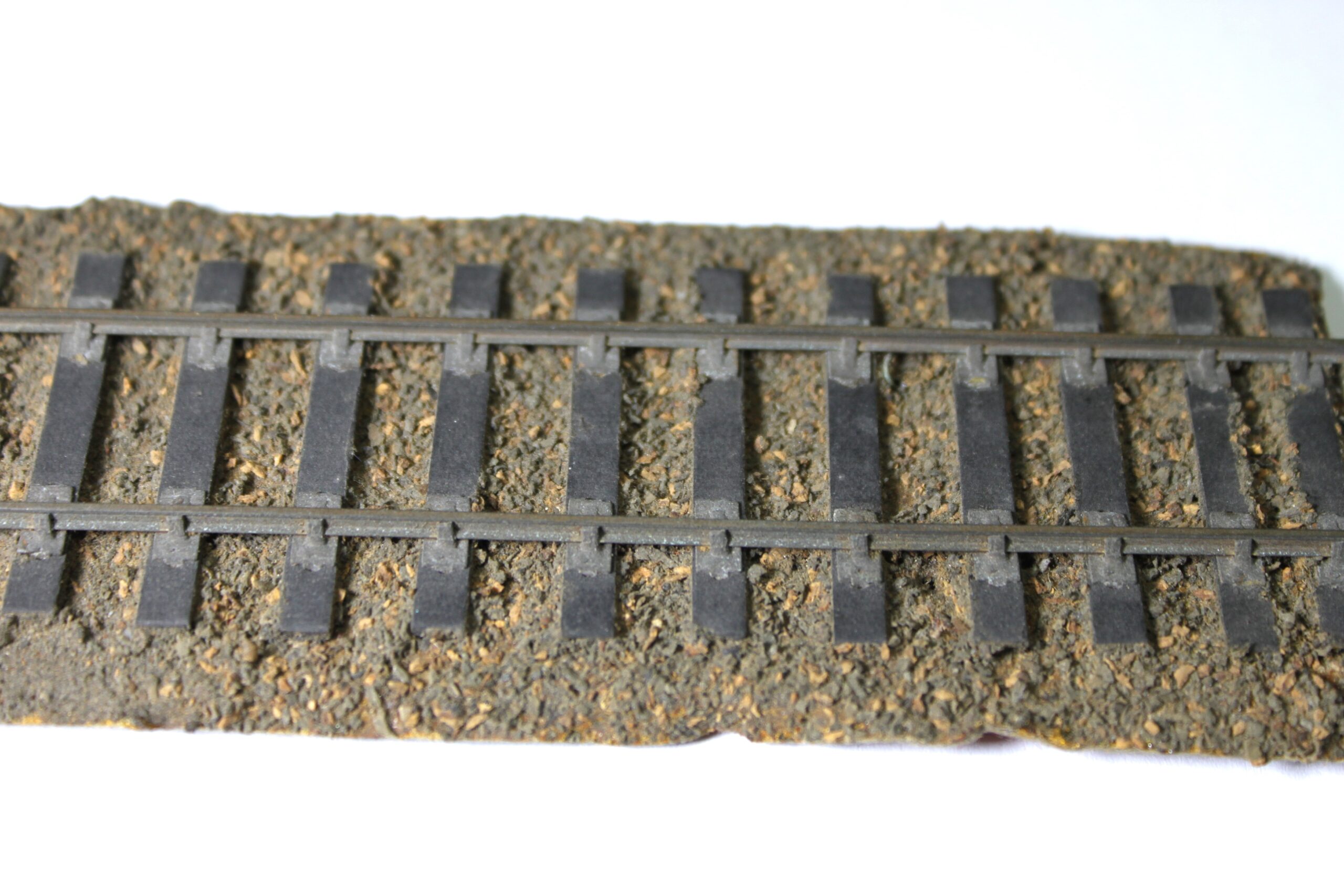
The track is assembled from Code 72 flat bottom rail held in pressed metal chairs mounted on black fibre sleepers. It is mounted on thick card and ballasted with what I think are cork granules. The chairs create a remarkably good impression of bullhead track.
I recall articles describing layouts built with use of Peco Code 65 conductor rail for EM gauge track in order to obtain a nearer scale appearance than was possible with the Code 95 or 98 (2.5 mm high) bullhead that was available at the time. I have not previously encountered the use of Code 72 rail to represent bullhead track.
I have some Code 72 rail, acquired for my colonial interests in ‘S’ Scale. I think this is all of American origin. Some certainly came from a friend with American HO and HOn3 interests. None is identical to the sample; there are variations in the width of the foot.
Has anyone encountered track constructed in this way? Or aware of any layouts using it still in existence?
I attach two photographs.
Attachments:
-
March 2, 2023 at 8:10 pm #244070
 Nigel BurbidgeParticipant
Hi Richard
Your photos look interesting and remind me a little of David Jenkinson’s description of the track he built for Garsdale Road. I think he used Kings Cross products and gained the impression, from his description in RM, that he threaded chairs onto rails and then glued them into position on sleepers. I wonder whether the track passed to you might have a similar provenance?
best wishes
Nigel
-
March 3, 2023 at 2:57 pm #244076Participant
The chairs are not the Kings Cross products. They are not glued, but fixed by tags on the chairs which pass through holes in the sleepers.
-
March 3, 2023 at 4:52 pm #244077Nigel BurbidgeParticipant
I guess other possibilities could be the Little Western system, Alan Brett Cannon’s Chairway track or even, possibly early Peco Individulay?
-
March 3, 2023 at 7:37 pm #244078Participant
Not Little western, which used staples to which the rail was soldered. I did have some of this, but the fibre base disintegrated. The holes for the staples took up most of the width of the sleepers. Not Allen Brett Cannon, which had plastic chairs. Did Peco Individulay use pressed metal chairs? I remember Peco spiked track in the early ’60’s, but not Individulay. The spikes worked loose in insulation board!
-
March 5, 2023 at 11:54 pm #244088Nigel BurbidgeParticipant
Hi Richard,
Possibly my last throw of the dice: could it be Elkway track?
best wishes
Nigel
-
January 24, 2024 at 4:51 pm #247803Participant
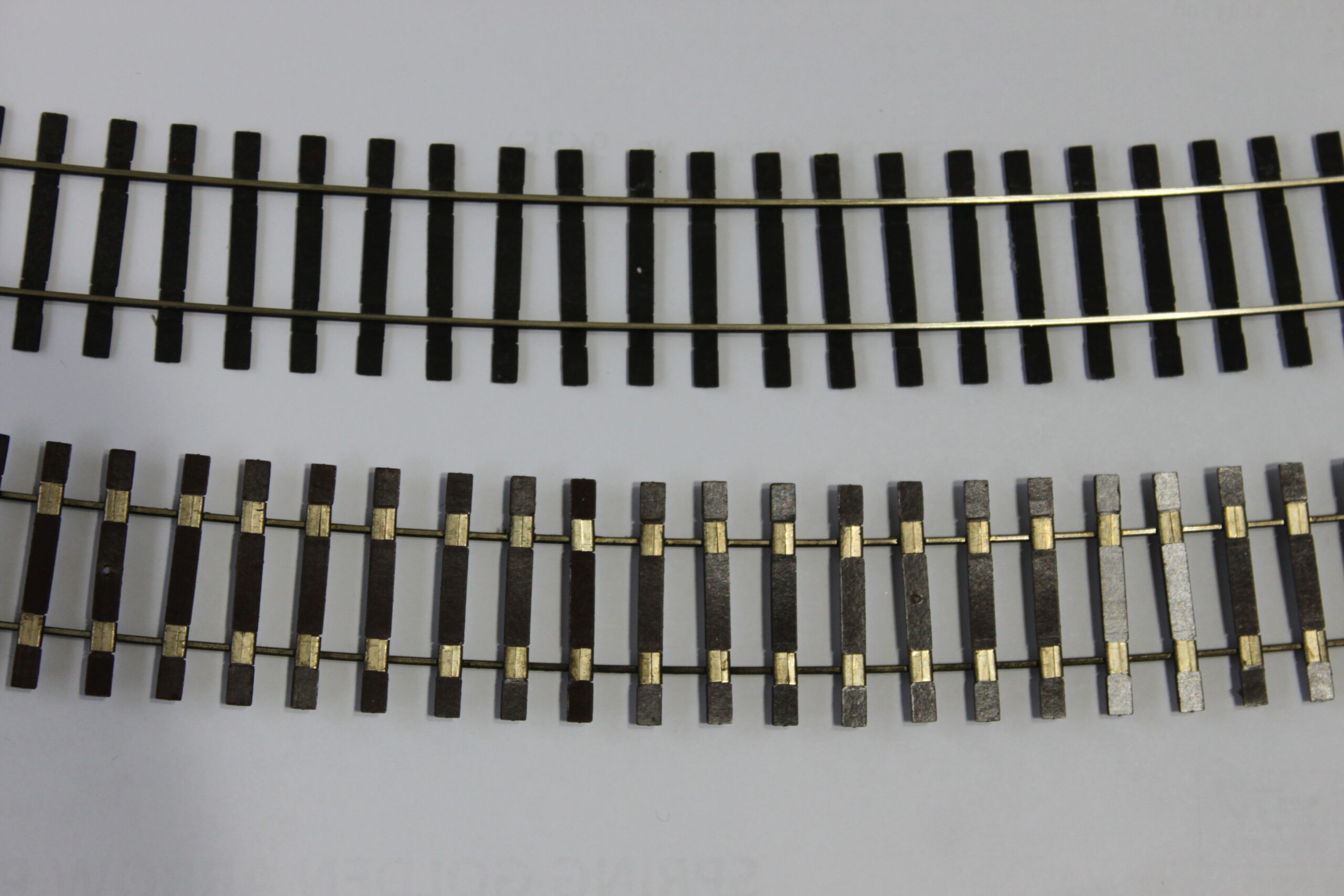
I have now collected the old EM track which was offered for disposal. I have examined the track and found that there are several different types in addition to that constructed from Romford parts. There is at least 15 yd of ‘Little Western’ track also using the Code 72 flat bottom rail, several varieties using the old 2.5 mm high bullhead rail and one using flat bottom rail. Those using bullhead rail include some ply-and-rivet track (or ply-and-brad?), some on printed circuit board sleepers and small quantities of two types that are new to me. One of these secures the rail by a thin nickel silver strip underneath pressed through holes in the sleeper and apparently spot welded to the underside of the rail. Another has rail soldered to plates wrapped tightly round the sleeper. The flat bottom rail has a groove in the base (Peco Code 90?) which appears to be soldered to soft metal studs passing through every fourth sleeper. Most of the studs have parted company with the rail and are missing. The spot welded type must have been factory assembled and is definitely not flexible. I assume that fixed radius curves would also have been available, but there are no samples in the collection. The flat bottom type must also have been factory assembled.
I attach photographs of the latter three types.
Can anyone identify any of the manufacturers?
-
-
AuthorPosts


- Only logged in EMGS members can reply to this topic